
No products in the cart.
How to Balance the Five Elements in Your Home: A Simple Feng Shui Guide
Introduction
Sometimes, what a space needs is better balance.
In Feng Shui, the Five Elements — Wood, Fire, Earth, Metal, and Water — offer a practical way to observe how colors, materials, shapes, light, and natural objects interact within your home.
But balancing the Five Elements does not mean placing one Wood object, one candle, one crystal, one metal decoration, and one bowl of water in every room.
It is much more subtle than that.
The goal is to understand what qualities are already present in your space, notice what may be dominating or missing, and make small, intentional adjustments.
In this guide, you’ll learn how to balance the Five Elements in your home, recognize common signs of imbalance, and use simple décor, natural materials, and crystals to create a space that feels more harmonious.
If you’re new to Feng Shui, start with our What Is Feng Shui? A Beginner’s Guide.
1. Start With the Feeling of the Room
Before thinking about which element your home “needs,” start with something much simpler:
How does the room actually feel?
Stand in the space for a moment and observe it without immediately trying to change anything.
Ask yourself:
- Does it feel warm or cold?
- Calm or restless?
- Open or cluttered?
- Soft or overly hard?
- Bright or dark?
- Natural or artificial?
- Grounded or visually unsettled?
Then look at what may be creating that feeling.
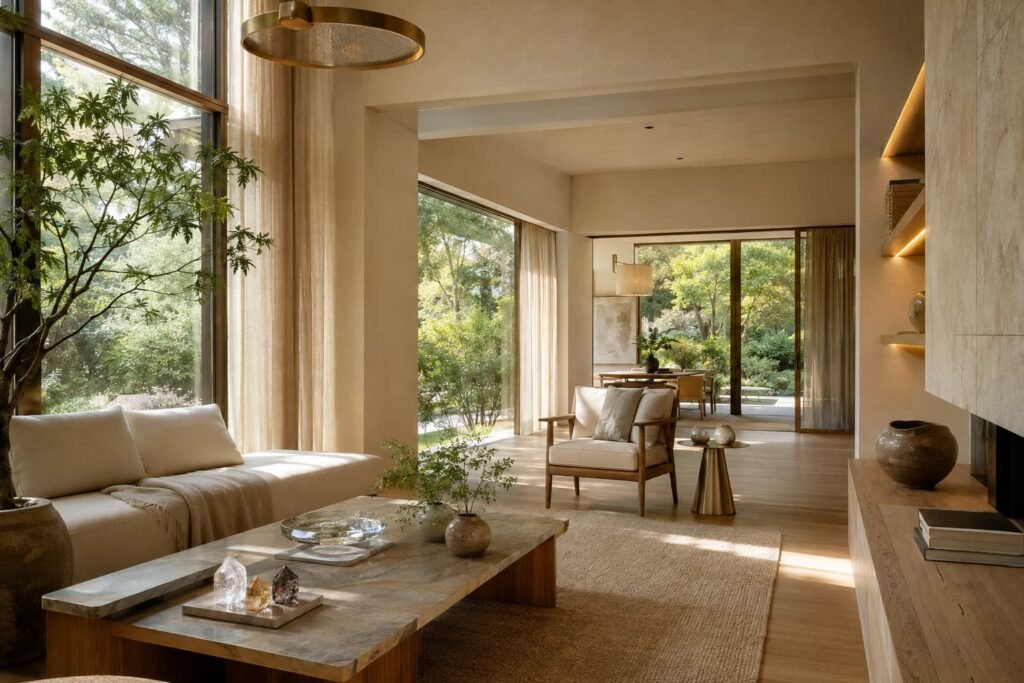
A room filled with plants and wooden furniture may already have a strong Wood presence.
A minimalist white office with metal furniture and sharp lines may lean toward Metal.
A dark room with black, blue, glass, and reflective surfaces may express more Water qualities.
This is more useful than immediately asking, “Which element is my home missing?”
Observe first. Adjust second.
2. How to Balance the Wood Element
Wood represents growth, renewal, flexibility, and natural vitality.
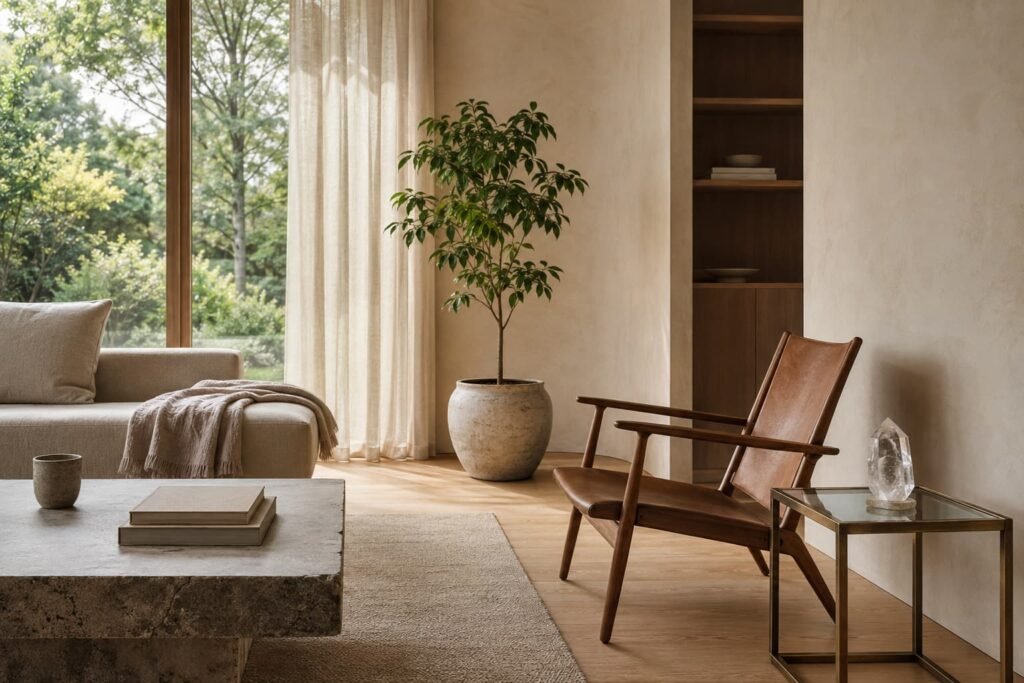
You may already have strong Wood qualities if your room contains many plants, wooden surfaces, green tones, botanical patterns, or tall vertical forms.
When Wood Feels Too Strong
A space dominated by Wood may sometimes feel visually busy or overly active, especially when there are too many plants, patterns, and natural textures competing for attention.
Try:
- Reducing unnecessary plants
- Creating more open visual space
- Adding neutral stone or ceramic pieces
- Introducing small Metal details
- Simplifying green-heavy décor
When You Want More Wood
If a room feels sterile, artificial, or disconnected from nature, introduce Wood gently through:
- One healthy plant
- Natural wooden furniture
- Linen or natural fibers
- Soft green accents
- Botanical artwork
A Green Aventurine or Moss Agate can also work beautifully beside plants and wooden surfaces, adding another natural texture without overwhelming the room.
3. How to Balance the Fire Element
Fire represents warmth, activity, visibility, and expression.
You do not need an actual fireplace to have Fire in a room. Sunlight, candles, warm lighting, red and orange accents, and energetic shapes can all express Fire qualities.
When Fire Feels Too Strong
Too much visual Fire may make a space feel overly stimulating or intense.
This can happen with strong red walls, harsh warm lighting, excessive candles, or too many bold accents.
Try:
- Replacing intense reds with softer neutrals
- Using gentler lighting
- Introducing earthy materials
- Adding deeper blue or dark accents
- Creating more visual breathing room
When You Want More Fire
If a room feels cold or lifeless, try:
- Warmer lighting
- A candle
- A small orange or red accent
- More natural sunlight
- Warm-colored textiles
For a subtle crystal accent, Carnelian or Red Jasper can introduce warm orange and earthy red tones.
You do not need many pieces. Fire often works best as an accent.
4. How to Balance the Earth Element
Earth represents stability, support, and groundedness.
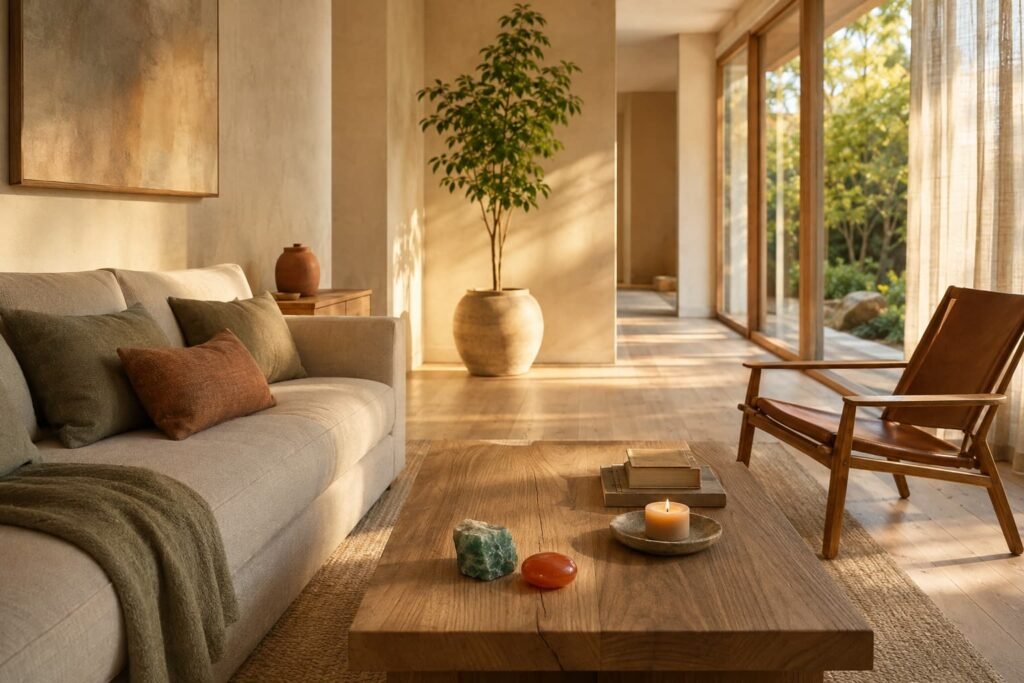
Stone, clay, ceramics, crystals, square shapes, and beige or sandy tones can all bring Earth qualities into a space.
When Earth Feels Too Strong
Too much Earth can sometimes make a room feel visually heavy, static, or overly neutral.
A room dominated by beige stone, heavy furniture, ceramics, and brown tones may benefit from more freshness or movement.
Try:
- Adding a plant
- Introducing lighter textiles
- Creating more open space
- Adding subtle reflective surfaces
- Bringing in gentle color
When You Want More Earth
If a space feels scattered or visually unsettled, try:
- Natural stone
- Handmade ceramics
- Clay objects
- Neutral earthy tones
- Stable, substantial furniture
Crystals naturally fit here because they are minerals formed within the Earth.
Citrine can bring a warm golden accent, while Smoky Quartz works beautifully with wood, stone, and neutral interiors.
5. How to Balance the Metal Element
Metal represents structure, precision, simplicity, and clarity.
White and gray tones, metallic finishes, circular forms, clean lines, and organized surfaces can all express Metal qualities.
When Metal Feels Too Strong
An overly Metal-dominant room may feel cold, rigid, or impersonal.
This can happen in very minimalist interiors with white walls, metal furniture, hard surfaces, and little natural texture.
Try:
- Adding plants
- Introducing natural wood
- Using softer textiles
- Adding warmer lighting
- Bringing in handmade or organic forms
When You Want More Metal
If a space feels chaotic or visually unstructured, Metal can be introduced through:
- Simple organization
- Clean lines
- Circular shapes
- White or gray accents
- Small metallic objects
Clear Quartz works especially well in bright, minimalist environments because of its transparent appearance and geometric crystal structure.
Pyrite offers a more obvious metallic texture and can work as a small visual accent.
6. How to Balance the Water Element
Water represents flow, adaptability, reflection, and depth.
Black and deep blue tones, glass, reflective materials, curved shapes, and water-inspired artwork can all suggest Water.
When Water Feels Too Strong
A room dominated by dark colors, reflective surfaces, or cool blue tones may feel too cold or withdrawn.
Try:
- Adding warm lighting
- Introducing natural wood
- Adding earthy textures
- Bringing in a healthy plant
- Using warmer neutral colors
When You Want More Water
If a room feels overly rigid or visually dry, introduce Water qualities through:
- Curved shapes
- Glass
- A mirror used thoughtfully
- Deep blue or black accents
- Artwork inspired by rivers or oceans
Black Obsidian can add dark, glass-like depth, while Aquamarine introduces a lighter blue, translucent quality that visually recalls water.
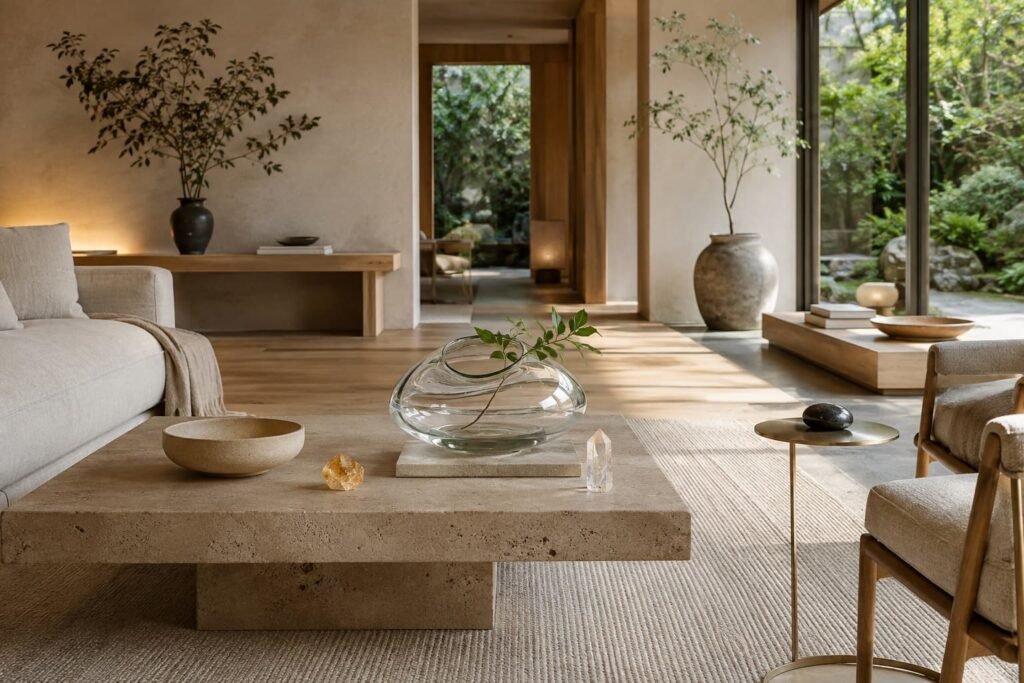
7. Do You Need All Five Elements in Every Room?
No.
This is one of the most common misunderstandings about balancing the Five Elements.
You do not need equal amounts of Wood, Fire, Earth, Metal, and Water in every room.
Different rooms serve different purposes.
A bedroom may benefit from softer, calmer qualities.
A workspace may need more structure and clarity.
A living room may work best with warmth, natural materials, and enough openness for people to gather comfortably.
Balance is not mathematical.
Think of the Five Elements as a vocabulary for understanding your environment — not a formula that tells you exactly how many objects of each type you need.
8. Balancing the Five Elements Room by Room
Living Room
The living room is often where different people, activities, and materials come together.
Start with a natural foundation such as wood, stone, or neutral textiles. Add plants for freshness, warm lighting for comfort, and a few structured or reflective details for contrast.
A thoughtfully placed crystal can work as a natural accent rather than becoming the center of the entire room.
Bedroom
For the bedroom, prioritize rest over visual stimulation.
Use softer textures, comfortable lighting, natural materials, and fewer decorative objects.
Avoid trying to include every element simply for the sake of Feng Shui.
A calm room with intentional choices is often more useful than a room filled with symbolic objects.
If you enjoy keeping crystals near your sleeping space, placement and practicality matter. You can explore our guide to Safe Crystals for Nightstand Placement for more ideas.
Home Office
A home office often benefits from a sense of structure without becoming sterile.
Metal qualities such as clean lines and organization can create clarity, while Wood elements such as a plant or wooden desk can soften the environment.
Natural light and a small crystal, such as Clear Quartz, can add visual interest without cluttering the workspace.
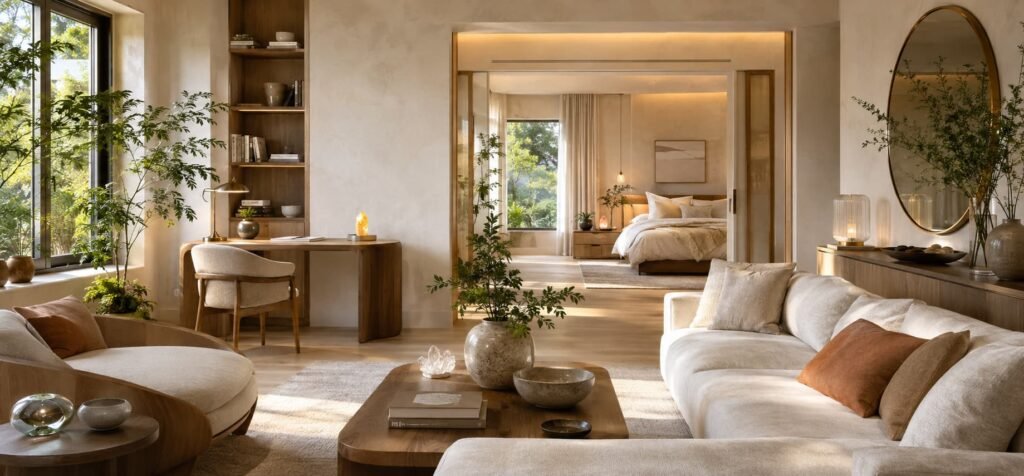
9. Using Crystals to Support the Five Elements
Crystals can be a beautiful way to bring natural color, texture, and geological character into a home.
But avoid thinking of them as shortcuts.
Placing five different crystals in a room does not automatically “balance” the Five Elements.
Instead, consider the crystal together with its surroundings.
A Green Aventurine beside a plant and wooden furniture may reinforce Wood qualities.
Carnelian beside warm lighting may echo Fire.
Citrine on a natural stone surface can complement Earth.
Clear Quartz in a clean workspace can visually support Metal.
Black Obsidian in a darker, reflective setting may connect naturally with Water.
The relationship matters more than the object alone.
If you are unsure where to begin, read our Best Crystal Placement Rules for Every Room: Living Room, Bedroom & Office.
10. Common Five Elements Mistakes to Avoid
When beginners start working with the Five Elements, a few misconceptions appear again and again.
Mistake 1: Trying to Make Every Element Equal
Balance does not mean equal quantities.
Your bedroom and office do not need the same elemental composition because they serve completely different purposes.
Mistake 2: Buying More Objects Before Observing the Space
You may not need anything new.
Sometimes removing clutter, opening the curtains, moving a plant, or changing the lighting creates a bigger difference than buying another decorative object.
Mistake 3: Treating Crystal Associations as Absolute Rules
Different traditions may associate crystals with elements in different ways.
Use color, material, context, and intention as guides rather than treating one chart as universal truth.
Mistake 4: Ignoring Practicality
A beautiful arrangement should still work for everyday life.
Do not block walkways, overcrowd bedside tables, place delicate crystals where they can easily fall, or sacrifice comfort simply to follow a symbolic rule.
11. A Simple Five Elements Check for Your Home
If you want to try this today, choose just one room.
Then follow these four steps:
Step 1 — Observe
Spend a minute looking at the room without changing anything.
Step 2 — Describe
Choose three words that describe how the room currently feels.
For example:
Cold. Clean. Empty.
or:
Warm. Natural. Crowded.
Step 3 — Identify
Look at the dominant colors, materials, shapes, and lighting. Which elemental qualities appear most strongly?
Step 4 — Adjust One Thing
Do not redesign the room.
Make one small change.
Move a plant.
Remove an unnecessary object.
Change the lighting.
Add a natural texture.
Reposition a crystal.
Then live with the change for a while and notice whether the room feels different.
12. DaoMind Perspective: Balance Is a Practice
At DaoMind, we do not see balance as a finished state.
Homes change.
Seasons change.
Light changes.
And the people living within a space change too.
A room that feels right today may need something different months from now.
That is why working with the Five Elements can be less about achieving a “perfect Feng Shui home” and more about developing awareness of your surroundings.
Observe.
Adjust.
Live with the change.
Then observe again.
This simple process reflects a deeper idea found throughout Daoist thought:
Harmony is not something we force. It is something we continually learn to respond to.
FAQ
How Do I Balance the Five Elements in My Home?
Start by observing the colors, materials, shapes, lighting, and atmosphere already present in your space. Identify which qualities feel dominant or lacking, then make small adjustments rather than trying to add all five elements equally.
Does Every Room Need All Five Feng Shui Elements?
No. Different rooms serve different purposes, so they do not need equal amounts of Wood, Fire, Earth, Metal, and Water.
How Can I Tell Which Feng Shui Element Is Missing?
Rather than trying to diagnose a “missing element” immediately, first observe how the room feels and which colors, materials, shapes, and textures already dominate it.
Can Crystals Help Balance the Five Elements?
Crystals can complement the Five Elements through their natural colors, textures, shapes, and placement. However, they work best as part of the overall environment rather than as a substitute for thoughtful space design.
What Is the Easiest Way to Start?
Choose one room and make one small adjustment based on how the space currently feels.
You might add a plant, soften the lighting, clear unnecessary objects, introduce a natural material, or simply reposition something you already own.
Bring More Intention Into Your Space
Ready to explore natural pieces for your home?
Discover the DaoMind Crystal Collection, thoughtfully selected to complement mindful living, natural interiors, and intentional spaces.
Not sure which crystal may suit your space? Contact DaoMind and tell us what you are looking for — we’ll be happy to help you explore the collection.
Share Post
About author

Related posts
26
8 月
Where to Place Amethyst i... Continue reading
15
8 月

The Five Elements in Feng... Continue reading
09
8 月
What Is Feng Shui? A Begi... Continue reading
02
8 月
Best Crystal Placement Ru... Continue reading
04
2 月
Feng Shui for Wealth and ... Continue reading
Add comment