No products in the cart.
The Five Elements in Feng Shui: Wood, Fire, Earth, Metal & Water Explained
Introduction
Have you ever wondered why one room feels warm and inviting, while another feels cold or unsettled — even when both are beautifully decorated?
Sometimes, the difference is not about how much furniture you have or how expensive the décor is. It can come from the relationship between colors, materials, shapes, light, and the natural elements within the space.
In traditional Chinese philosophy, one way of understanding these relationships is through the Five Elements in Feng Shui: Wood, Fire, Earth, Metal, and Water.
Rather than existing separately, the Five Elements interact with one another in a continuous cycle of growth, transformation, and balance. This idea became an important framework in Feng Shui for understanding how different qualities can work together within an environment.
And for those who enjoy bringing natural crystals into their homes, the Five Elements can also offer a thoughtful way to consider crystal colors, textures, and placement — without treating them as rigid rules.
In this beginner’s guide, we’ll explore what the Five Elements mean, how they interact, which crystals can visually complement each element, and simple ways to bring these principles into a modern home.

Quick Guide: The Five Elements in Feng Shui
Wood — Growth & Vitality
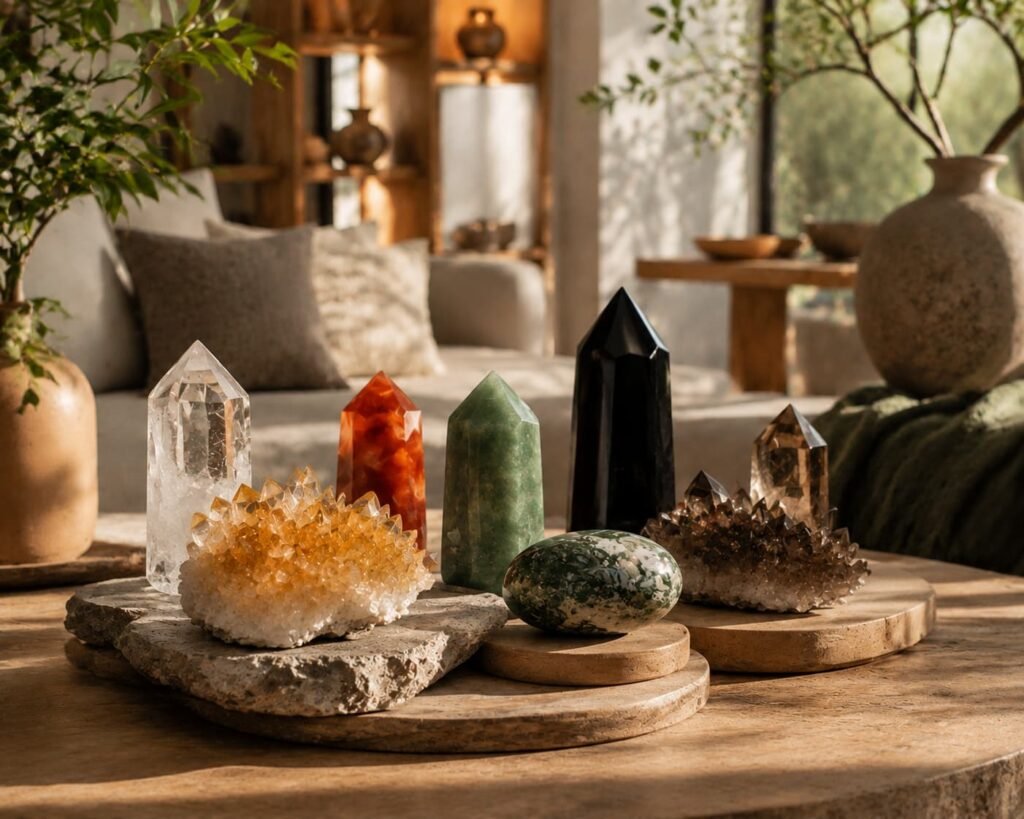
Crystal examples: Green Aventurine, Moss Agate
Fire — Warmth & Expression
Crystal examples: Carnelian, Red Jasper
Earth — Stability & Grounding
Crystal examples: Citrine, Smoky Quartz
Metal — Structure & Clarity
Crystal examples: Clear Quartz, Pyrite
Water — Flow & Reflection
Crystal examples: Black Obsidian, Aquamarine
The goal of working with the Five Elements is not to fill your home with equal amounts of all five. It is about understanding their different qualities and creating a relationship between them that feels appropriate for your space.
1. What Are the Five Elements in Feng Shui?
The Five Elements are known in Chinese as Wu Xing
Although they are commonly translated as “five elements,” Wu Xing can also be understood as five phases or patterns of change.
This distinction is important.
Wood, Fire, Earth, Metal, and Water are not simply five physical materials. Each represents a broader set of qualities, movements, seasons, colors, and relationships found in nature.
For example, Wood is associated with growth and expansion, while Water is associated with flow and adaptability.
Feng Shui uses these qualities as a framework for thinking about how different parts of an environment interact.
Instead of simply asking whether a room has “enough” of a particular element, it can be more useful to ask:
What does this space need more of — warmth, stability, movement, softness, or structure?
That question brings the Five Elements out of ancient philosophy and into everyday life.
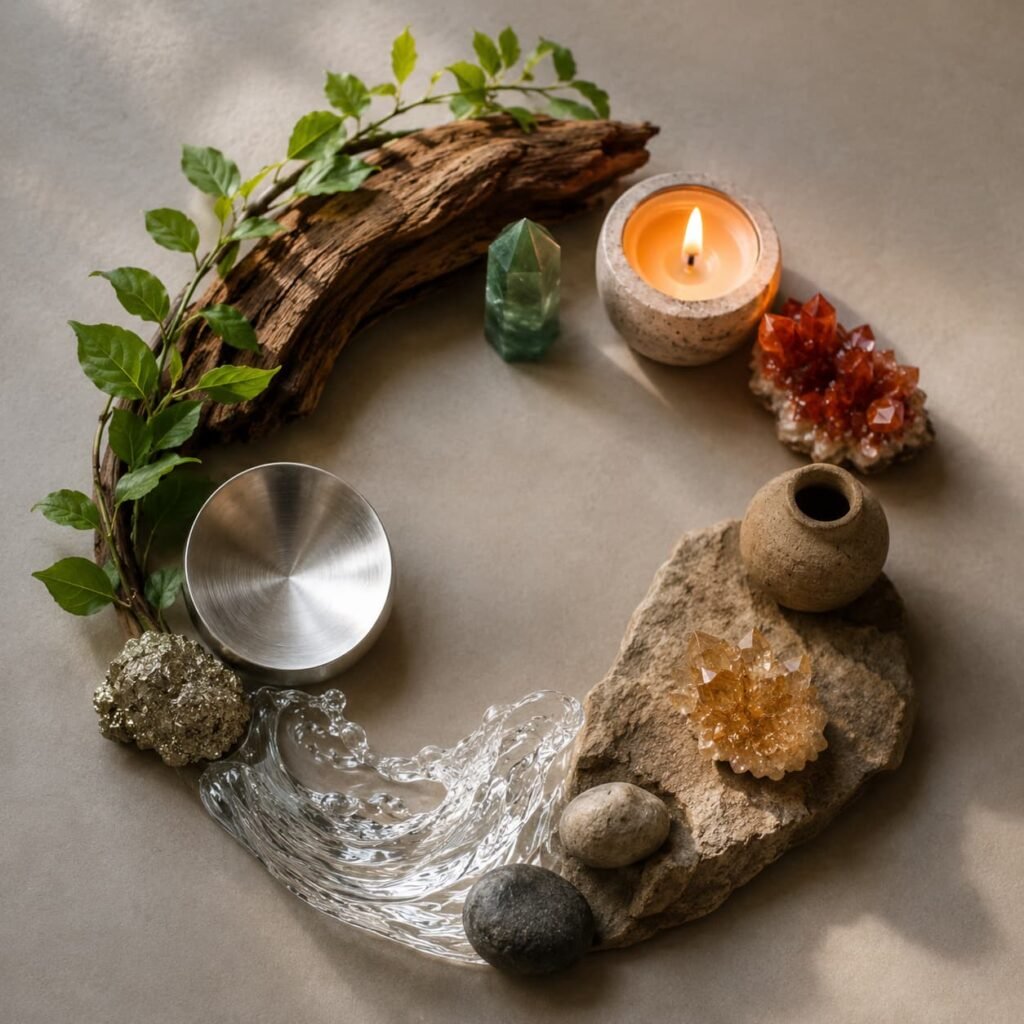
2. Wood Element: Growth & Vitality
The Wood element represents growth, renewal, flexibility, and upward movement.
Think of a young tree reaching toward sunlight. Wood carries a sense of development and natural vitality.
In a home, Wood can be represented through:
- Living plants
- Wooden furniture
- Natural fibers
- Green tones
- Vertical shapes
Wood elements often work naturally in living rooms, workspaces, reading areas, and other spaces where you want to create a sense of freshness and connection with nature.
Crystals That Complement the Wood Element
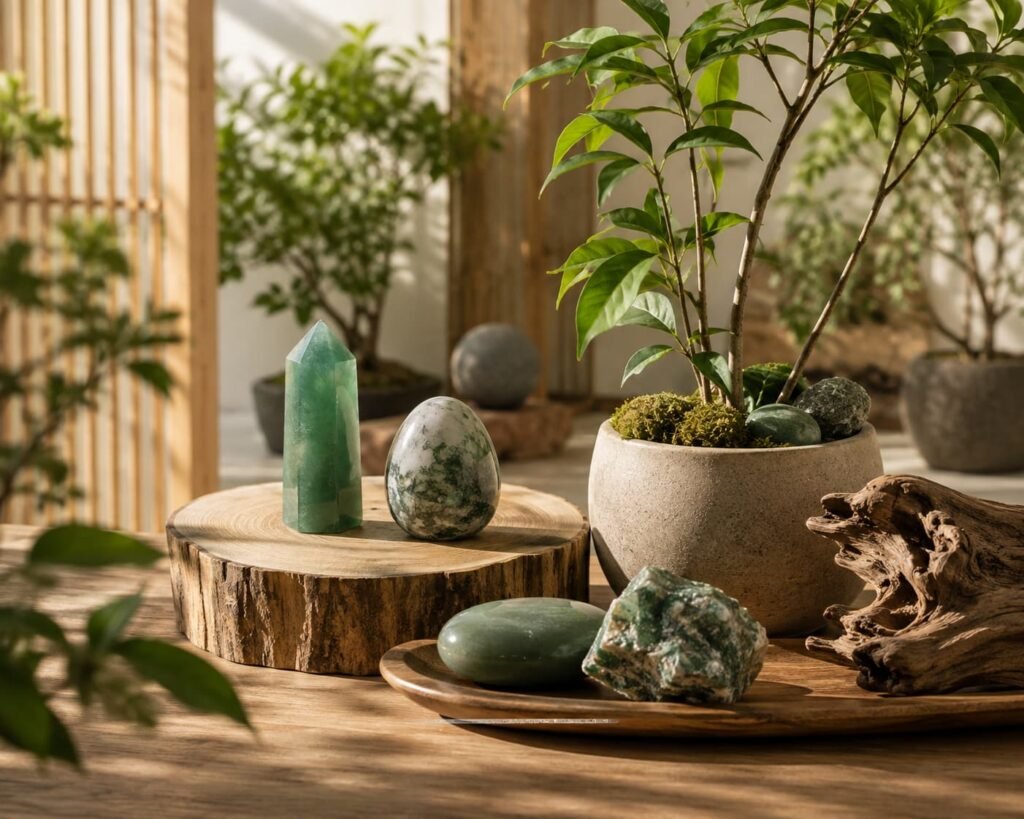
Crystals with natural green tones can also complement Wood-inspired spaces.
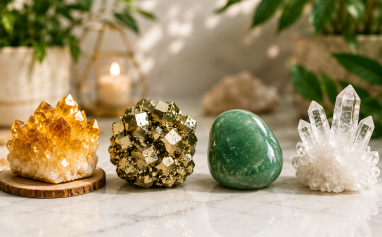
Green Aventurine, with its soft green color, works beautifully alongside plants and wooden furniture.
Moss Agate, known for its earthy, plant-like patterns, can visually evoke forests, moss, and natural growth.
Rather than thinking of these as fixed “Wood crystals,” consider how their colors and natural appearance can help express the qualities associated with Wood.
3. Fire Element: Warmth & Expression
The Fire element is associated with warmth, activity, visibility, and expression.
Sunlight is one of the simplest natural expressions of Fire.
Candles, fireplaces, warm lighting, and certain colors can also introduce Fire qualities into a space.
Common ways to represent Fire include:
- Natural sunlight
- Candles
- Warm lighting
- Red and orange accents
- Triangular or pointed forms
A small amount of Fire can make a room feel warmer and more inviting.
Crystals That Complement the Fire Element
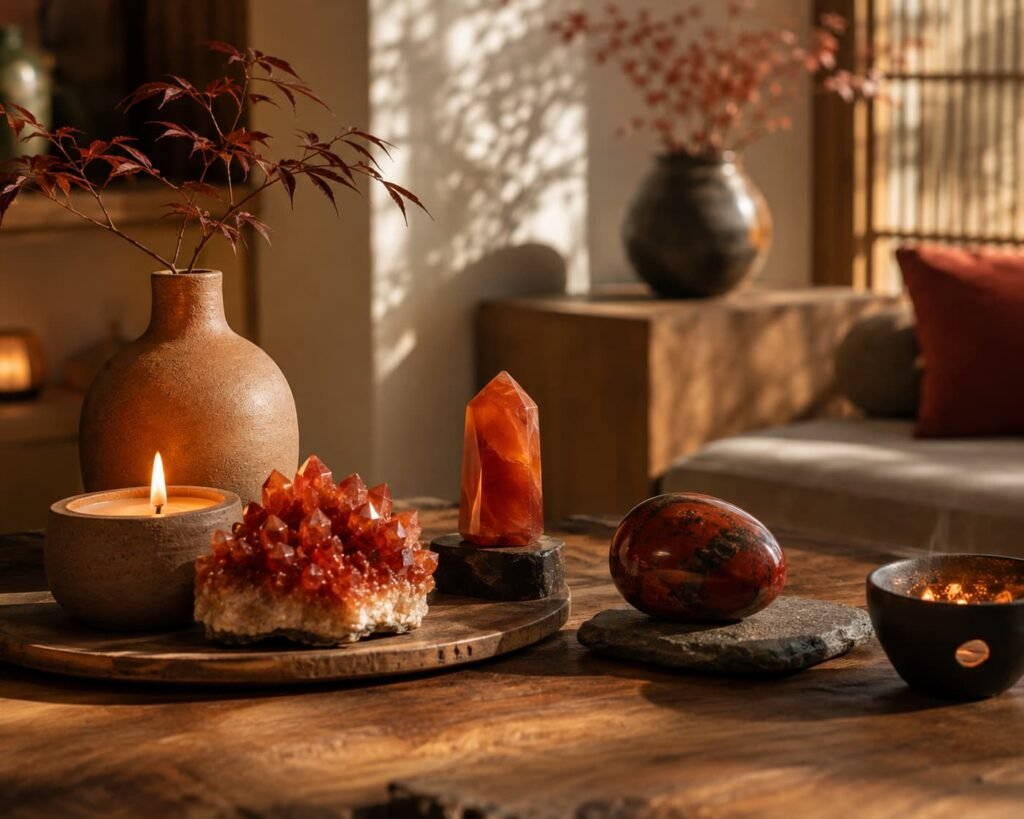
Warm red and orange crystals can echo the visual character of Fire.
Carnelian, with its rich orange-red color, can create a warm focal point in a room.
Red Jasper offers deeper, earthy red tones that pair naturally with warm lighting, ceramics, and wood.
Because Fire is visually powerful, you do not need much. A single warm-colored crystal can be enough to create a subtle accent.
4. Earth Element: Stability & Grounding
The Earth element represents stability, support, nourishment, and groundedness.
Natural stone, ceramics, clay, earthy colors, and solid forms are simple ways to introduce Earth qualities into a home.
Earth can appear through:
- Natural stone
- Crystals
- Ceramics
- Clay objects
- Beige, sand, and earthy tones
- Square and stable forms
Crystals fit especially naturally here because they are minerals formed within the Earth itself.
Crystals That Complement the Earth Element
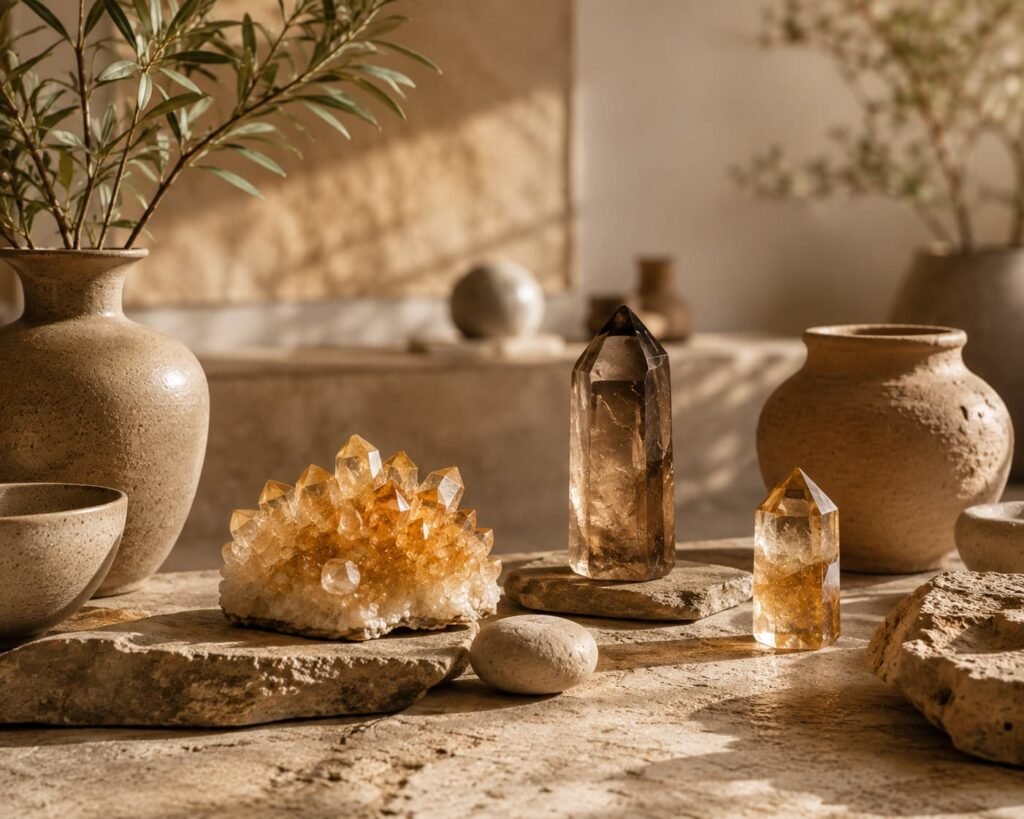
Citrine, with its warm golden tones, can complement beige, wood, stone, and other natural materials.
Smoky Quartz offers deeper brown and translucent shades that work beautifully with ceramics, natural stone, and wooden surfaces.
Crystals can therefore be appreciated not only for their symbolism, but also as tangible pieces of the natural world — bringing geological texture, color, and character into a home.
5. Metal Element: Structure & Clarity
The Metal element is associated with structure, precision, simplicity, and clarity.
In interior spaces, Metal can be represented through:
- Metal furniture and accessories
- White, gray, and metallic tones
- Circular shapes
- Clean lines
- Minimalist organization
Metal qualities can be especially useful in workspaces or areas where you want the environment to feel clean, organized, and intentional.
Crystals That Complement the Metal Element
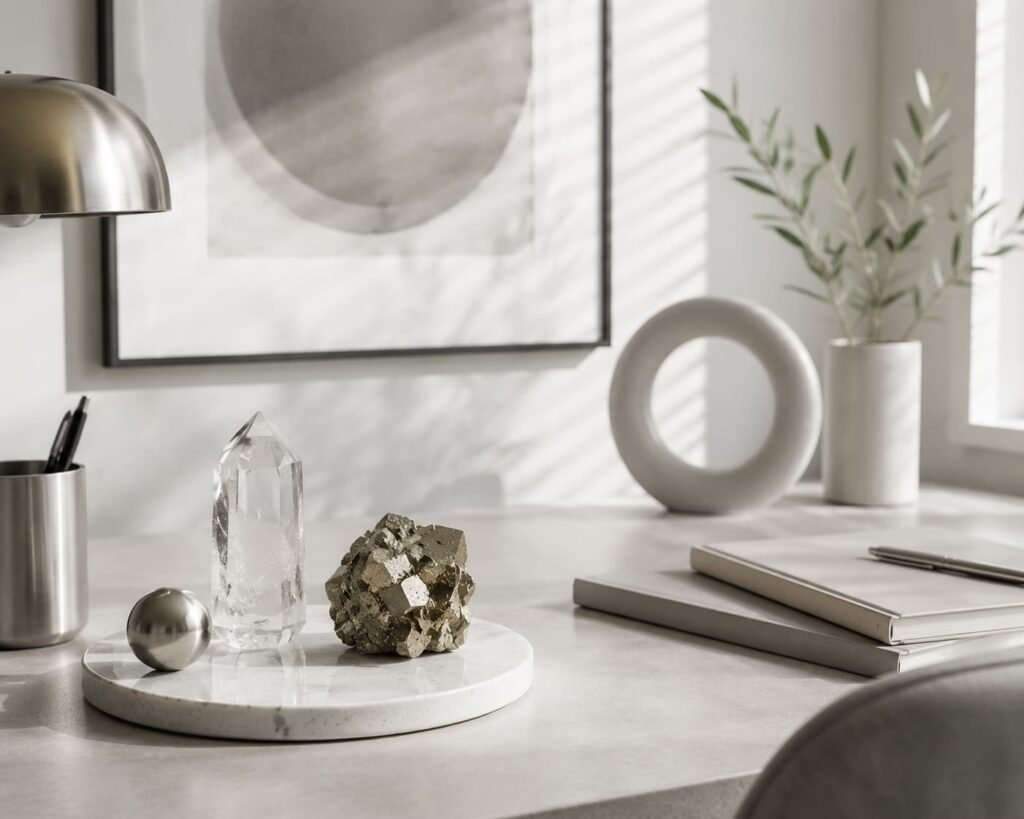
Clear Quartz works beautifully in bright, minimalist spaces because of its transparent appearance and clean geometric crystal formations.
Pyrite, with its naturally metallic luster and distinctive geometric structure, offers an even more direct visual connection with the Metal element.
These crystals can work particularly well alongside clean surfaces, neutral colors, and subtle metallic details.
If you want to learn more about Clear Quartz, explore our Clear Quartz Crystal Guide.
6. Water Element: Flow & Reflection
The Water element represents flow, adaptability, reflection, and depth.
Water can be introduced literally through water features, but it can also be represented more subtly through:
- Black and deep blue tones
- Glass
- Reflective surfaces
- Curved and flowing shapes
- Artwork inspired by rivers or oceans
Water reminds us that not everything needs to remain fixed.
In nature, water adapts to its surroundings while continuing to move.
Crystals That Complement the Water Element
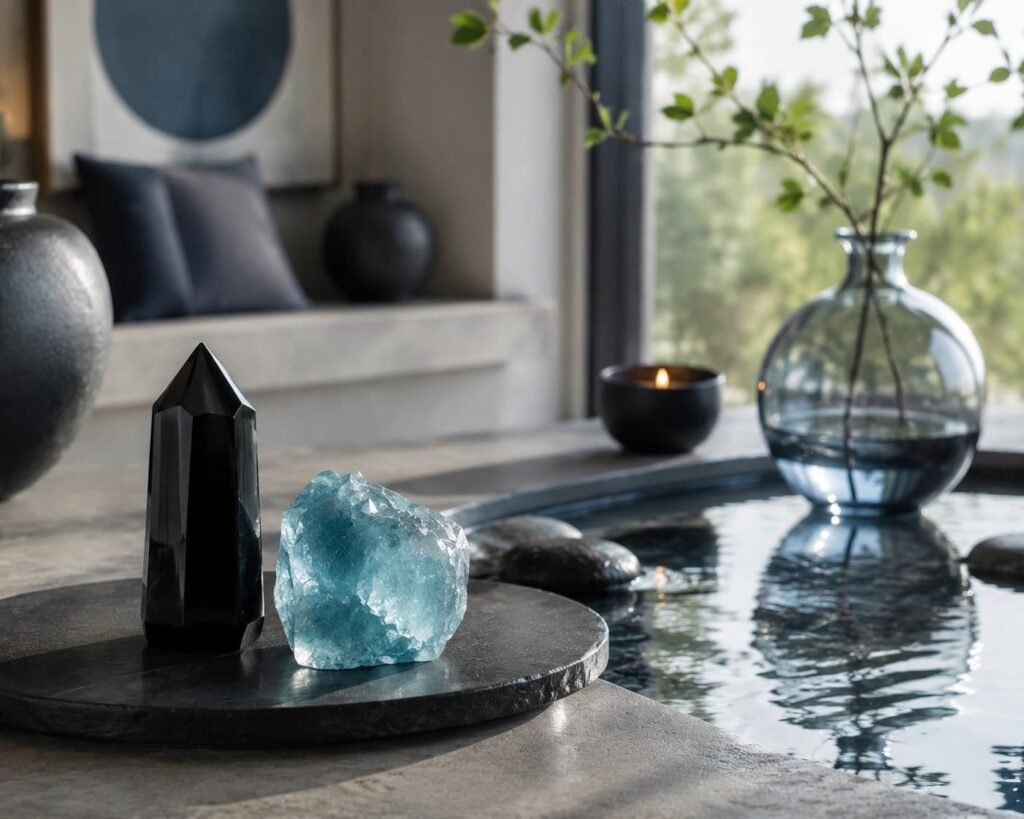
Dark and blue-toned crystals can work naturally within this visual language.
Black Obsidian, with its dark, glass-like surface, can add visual depth to a space.
Aquamarine, with its soft blue and translucent appearance, naturally recalls clear water and gentle movement.
Placed thoughtfully, these stones can become subtle natural accents rather than overpowering decorative objects.
7. How the Five Elements Work Together
One of the most important ideas behind the Five Elements is that they do not exist independently.
They interact through different cycles.
The best-known is the generating cycle:
Wood → Fire → Earth → Metal → Water → Wood
Traditionally, this relationship is described as:
Wood feeds Fire.
Fire produces ash, returning to Earth.
Earth gives rise to Metal.
Metal is traditionally associated with generating Water.
Water nourishes Wood.
There is also a controlling cycle:
Wood → Earth → Water → Fire → Metal → Wood
Wood controls Earth.
Earth controls Water.
Water controls Fire.
Fire controls Metal.
Metal controls Wood.
These relationships reveal an important idea:
Balance in traditional Chinese philosophy is dynamic rather than static.
Harmony does not mean that everything must exist in equal amounts.
Different forces can support, regulate, and respond to one another.
8. How to Use the Five Elements in Your Home
You do not need to redesign your entire home to begin exploring the Five Elements in Feng Shui.
Start by observing.
Walk into a room and notice its colors, materials, light, shapes, and overall atmosphere.
Does the room feel too cold?
Natural wood, plants, warm-colored crystals, or softer lighting may help create warmth.
Does it feel visually crowded?
Simplifying the décor and introducing clearer structure may make the space feel calmer.
Does it feel flat or lifeless?
Plants, natural textures, crystals, or a small warm accent can add visual interest.
The goal is not to follow a rigid formula.
Instead, use the Five Elements as a way to become more aware of how your surroundings make you feel.
If you are new to Feng Shui, explore our What Is Feng Shui? A Beginner’s Guide to Creating Harmony at Home for a broader introduction.
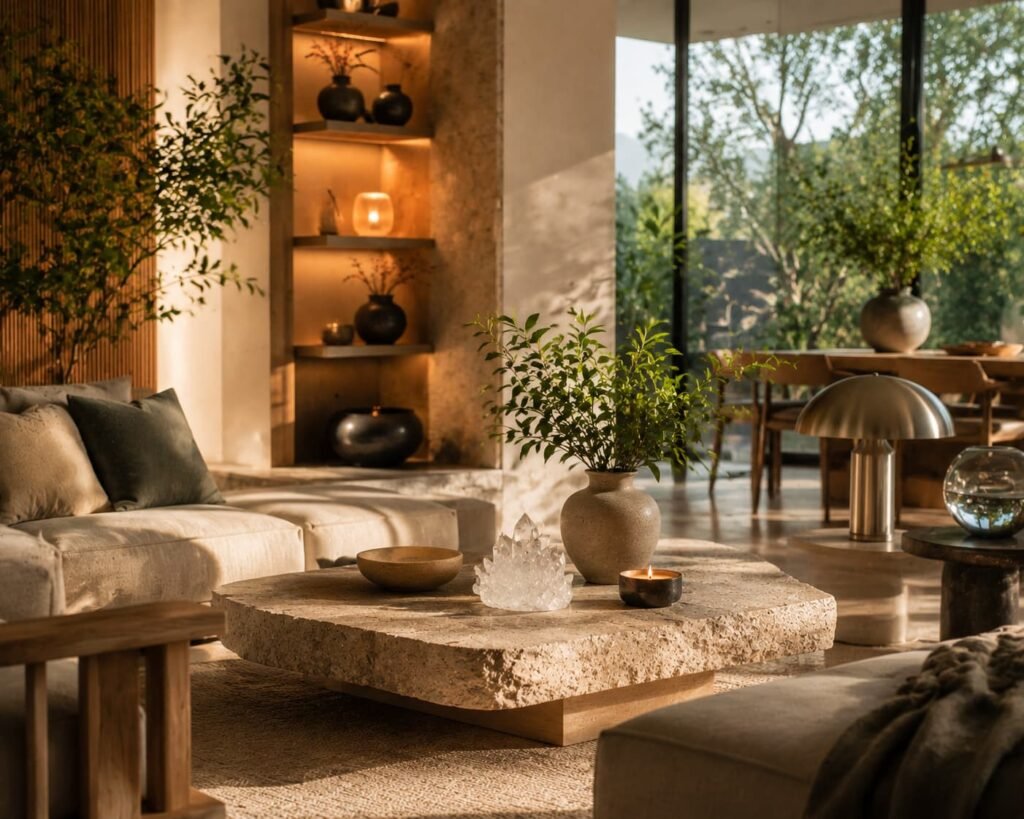
9. Crystals and the Five Elements
Crystals can be a beautiful way to introduce natural materials, colors, textures, and symbolism into your living space.
But it is important not to treat every crystal as permanently belonging to one specific element.
Different Feng Shui traditions and modern crystal practices may interpret these relationships differently.
A more flexible approach is to consider:
- Color
- Mineral characteristics
- Shape
- Texture
- Placement
- The surrounding materials
- Your personal intention
A green crystal placed beside a plant and wooden furniture may naturally reinforce the visual qualities of Wood.
A warm orange crystal beside a candle may echo Fire.
A clear geometric crystal in a minimalist workspace may complement Metal.
A dark, glass-like stone in a reflective space may visually connect with Water.
In this way, the relationship between crystals and the Five Elements becomes less about following a fixed chart and more about creating a thoughtful relationship between nature, space, and intention.
For more practical ideas, explore our Best Crystal Placement Rules for Every Room: Living Room, Bedroom & Office.
10. DaoMind Perspective: Balance Is Always Changing
At DaoMind, we see the Five Elements as more than a decorating system.
They offer a way to observe change.
Nature is never completely still.
Seasons shift.
Light changes throughout the day.
Plants grow.
Water moves.
And our own needs change with time.
A home can be approached in the same way.
Instead of trying to create a “perfect” space once and for all, we can continue adjusting our surroundings as our lives change.
This reflects a deeper idea found throughout Daoist thought:
Harmony is not about controlling everything. It is about learning how to move with change.
When we understand our surroundings more carefully, even small choices — opening a window, moving a plant, clearing a crowded table, or adding a natural crystal — can become part of a more intentional way of living.
FAQ
What Are the Five Elements in Feng Shui?
The Five Elements in Feng Shui are Wood, Fire, Earth, Metal, and Water. In traditional Chinese philosophy, they represent different qualities and patterns of change that interact with one another.
What Do the Five Elements Represent?
Wood is associated with growth and renewal, Fire with warmth and expression, Earth with stability, Metal with structure and clarity, and Water with flow and adaptability.
What Crystals Represent the Five Elements?
There is no single universally accepted crystal-to-element system. However, crystals can be paired with the Five Elements based on their color, appearance, mineral characteristics, and surrounding environment.
For example, Green Aventurine may complement Wood-inspired spaces, Carnelian can visually echo Fire, Citrine can work with Earth tones, Clear Quartz can complement Metal-inspired minimalism, and Black Obsidian can reflect the depth associated with Water.
Do I Need All Five Elements in Every Room?
Not necessarily.
The Five Elements are better understood as a framework for balance rather than a checklist requiring equal amounts of every element in every room.
How Can Beginners Use the Five Elements at Home?
Start with your existing space.
Observe its colors, materials, light, shapes, and atmosphere. Then make small adjustments using plants, wood, natural stone, crystals, lighting, metal objects, or flowing forms.
Conclusion: Creating Balance, Not Perfection
The Five Elements in Feng Shui offer a simple but meaningful way to understand the relationship between nature and our living spaces.
Wood reminds us of growth.
Fire brings warmth.
Earth creates stability.
Metal introduces structure.
Water encourages flow.
Natural crystals can become part of this relationship too — not because every stone must fit into a rigid category, but because their colors, textures, and geological origins allow us to bring pieces of the natural world into our everyday spaces.
But Feng Shui is not about filling a room with five objects and expecting instant transformation.
It is about paying attention.
When we begin noticing how light, materials, colors, natural objects, and space interact, we become more intentional about the environments we create.
Start small.
Observe your home, make one thoughtful change, and notice how the space feels.
Because sometimes, creating harmony does not require adding more.
It simply requires understanding what is already there.
Bring Natural Balance Into Your Space
Understanding the Five Elements is only the beginning. The next step is discovering which natural pieces feel right for your home, your space, and your personal intention.
Explore the DaoMind Crystal Collection to discover natural crystals selected for mindful living and harmonious spaces.
Not sure which crystal is right for you, or have questions about a piece in our collection? Contact DaoMind — we’ll be happy to help you explore your options.
Tags: Chinese Philosophy, Daoist Wisdom, Feng Shui Crystals, Feng Shui Five Elements, Feng Shui Principles, Five Elements, Five Elements Crystals, Five Elements in Feng Shui, Home Harmony, Wood Fire Earth Metal Water, Wu Xing
Share Post
About author

Related posts
26
8 月
Where to Place Amethyst i... Continue reading
18
8 月
How to Balance the Five E... Continue reading
09
8 月
What Is Feng Shui? A Begi... Continue reading
02
8 月
Best Crystal Placement Ru... Continue reading
04
2 月
Feng Shui for Wealth and ... Continue reading
Add comment