
No products in the cart.
Amethyst Meaning: Properties, Uses & How to Use Amethyst in Daily Life
Introduction
Have you ever been drawn to an amethyst before knowing anything about it?
Maybe it was the deep violet color, the natural crystal points, or simply the way it stood out among other stones.
Amethyst is one of the most recognizable crystals in the world, but there is much more to it than its beautiful purple appearance.
For centuries, amethyst has appeared in jewelry, decorative objects, and cultural traditions. Today, it remains popular among people who enjoy crystals, mindful living, meditation spaces, and natural home décor.
But what does amethyst meaning really refer to? What is amethyst made of? Where can you place it? And how can you incorporate it into everyday life without turning your home into a collection of symbolic objects?
In this guide, we’ll explore amethyst meaning, its natural properties, traditional symbolism, practical uses, care tips, and simple ways to bring amethyst into your daily environment.
If you’re new to crystals and aren’t sure where to begin, you may also want to explore our 【Best Crystals for Beginners】 guide.
1. What Is Amethyst?
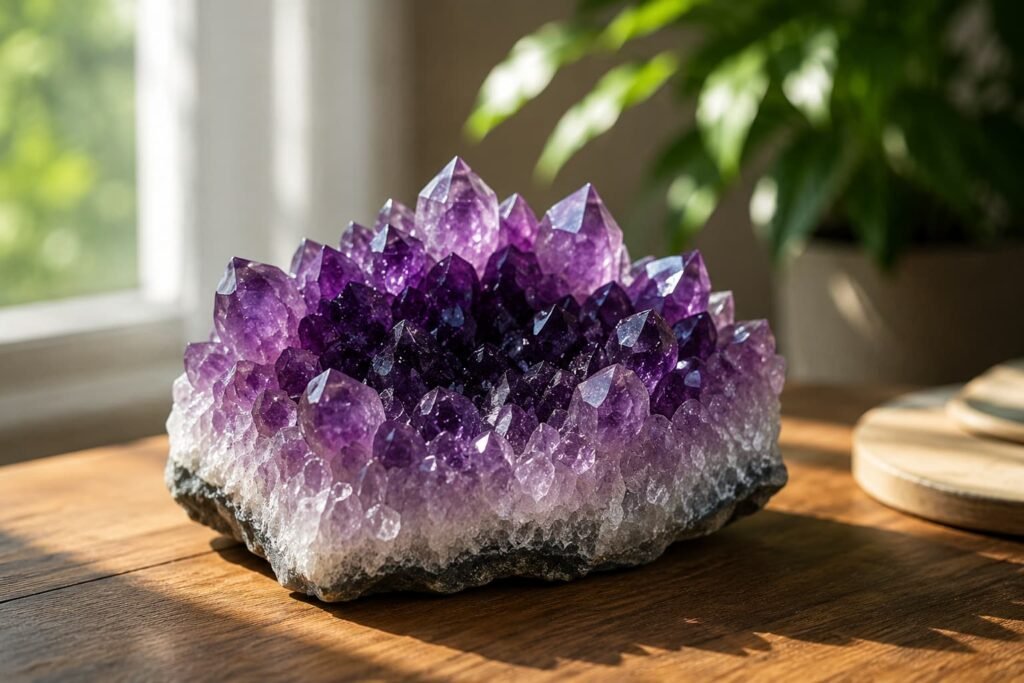
Amethyst is the purple variety of quartz, one of the most familiar mineral families found in nature.
Its chemical composition is silicon dioxide (SiO₂), the same basic composition found in other varieties of quartz. Amethyst colors can range from pale lilac and soft violet to rich reddish-purple and deep purple.
Natural amethyst may also show lighter and darker areas rather than appearing perfectly uniform. These natural variations are part of what gives individual stones their distinctive character.
With a Mohs hardness of about 7, amethyst is relatively durable and has long been used for jewelry, carvings, decorative pieces, and natural crystal specimens.
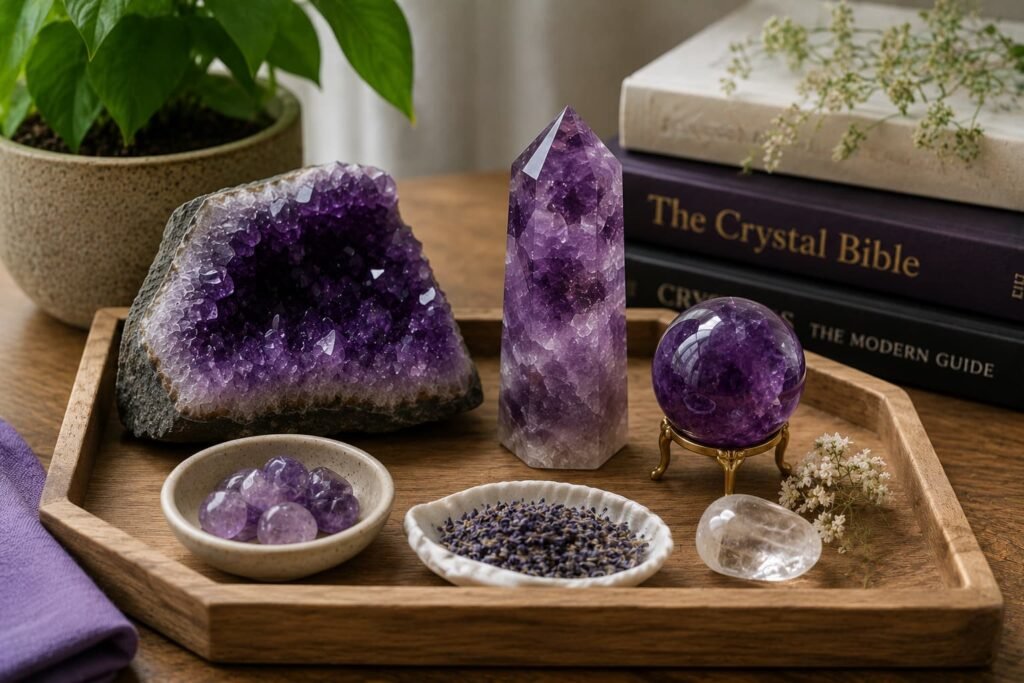
You may encounter amethyst in many different forms, including:
- Natural clusters
- Crystal points
- Geodes
- Tumbled stones
- Polished freeforms
- Spheres
- Jewelry
Each form creates a different visual impression, but they all belong to the same purple variety of quartz.
2. Amethyst Meaning & Symbolism
The meaning associated with amethyst has developed across different cultures and historical periods.
The name amethyst comes from the ancient Greek word amethystos, historically connected with the idea of avoiding intoxication. Because of this long cultural history, amethyst gradually became associated with meanings that went far beyond its physical appearance.
In modern crystal traditions, amethyst meaning is commonly connected with ideas such as:
- Calm
- Clarity
- Reflection
- Intuition
- Mindfulness
- Inner awareness
These are best understood as traditional and symbolic associations rather than scientifically established medical effects.
For many people today, amethyst does not need to promise a specific result to have meaning.
It can simply serve as a physical reminder to slow down, create a quiet moment, reflect, or approach daily life with greater intention.
Sometimes, that simple reminder is enough.
3. Why Is Amethyst Purple?
One of the defining characteristics of amethyst is its beautiful purple color.
Natural amethyst can range from very pale violet to intense purple and reddish-purple. Some crystals appear highly transparent, while others contain visible inclusions or variations in color.
This also means that two natural amethyst pieces do not have to look identical.
Some are light and translucent.
Others are deep and dramatic.
Some show noticeable color zoning.
Others appear much more uniform.
These variations are part of what makes natural stone interesting.
When choosing natural amethyst, it is better to appreciate the individual color, formation, inclusions, and character of each piece rather than expecting every crystal to look exactly like a product photograph.
Natural variation is not necessarily a flaw — it is part of the character of natural crystal.
4. How to Use Amethyst in Daily Life
You do not need an elaborate ritual to enjoy amethyst.
One of the easiest approaches is simply to place it somewhere that supports the way you already live.
Keep It in a Quiet Corner
A small amethyst cluster can work beautifully in a reading corner, beside a journal, or on a shelf where you naturally spend quieter moments.
The crystal becomes part of the environment rather than the focus of the entire space.
Add It to a Meditation Space
If you meditate, practice breathing exercises, or simply spend a few minutes in silence each day, amethyst can be placed nearby as a visual anchor.
You do not need to hold it or follow a complicated ritual.
Simply seeing the stone can become part of a routine that signals:
This is my time to slow down.
If you enjoy creating small intentional routines at home, explore more ideas in our 【内链:Mindful Living】 guides.
Keep a Small Piece on Your Desk
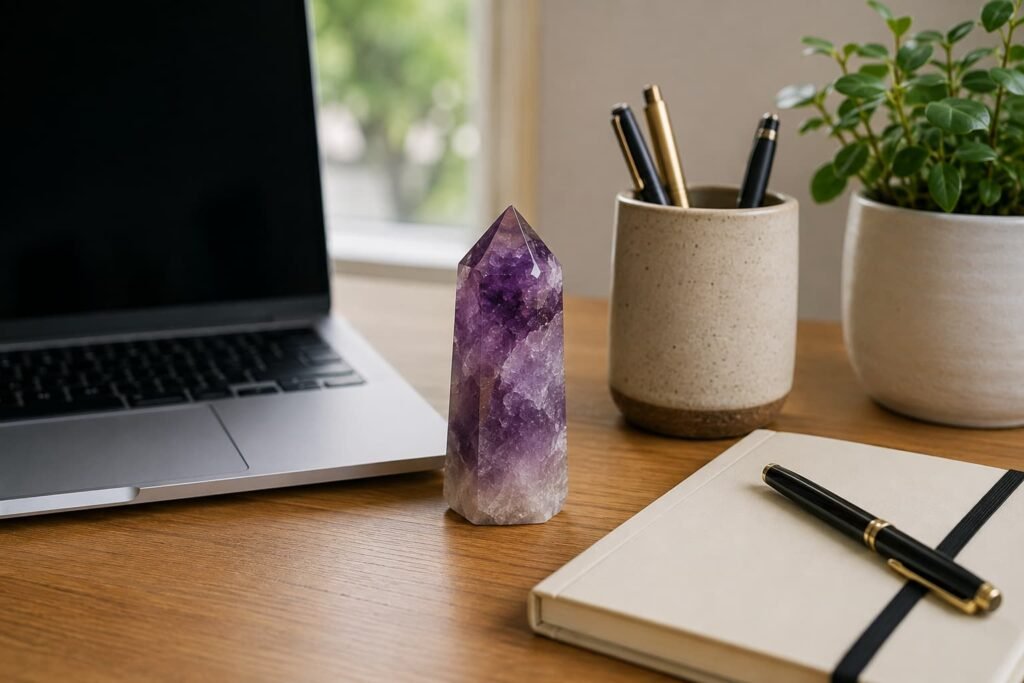
An amethyst point, cluster, or tumbled stone can also be used as a natural desk accent.
Place it somewhere visible without allowing it to contribute to clutter.
The goal is not to fill your workspace with crystals. One thoughtfully chosen object often creates a stronger impression than many competing pieces.
Use It as Part of a Personal Ritual
You might place amethyst beside a journal while writing, hold a small piece during a few minutes of quiet reflection, or simply pause beside it before beginning your evening routine.
The object does not create the habit.
You do.
The crystal simply becomes part of the environment that supports it.
5. Where Should You Place Amethyst at Home?
There is no single “correct” place for amethyst.
The best location depends on why you want it in the room and how you actually use that space.
Bedroom
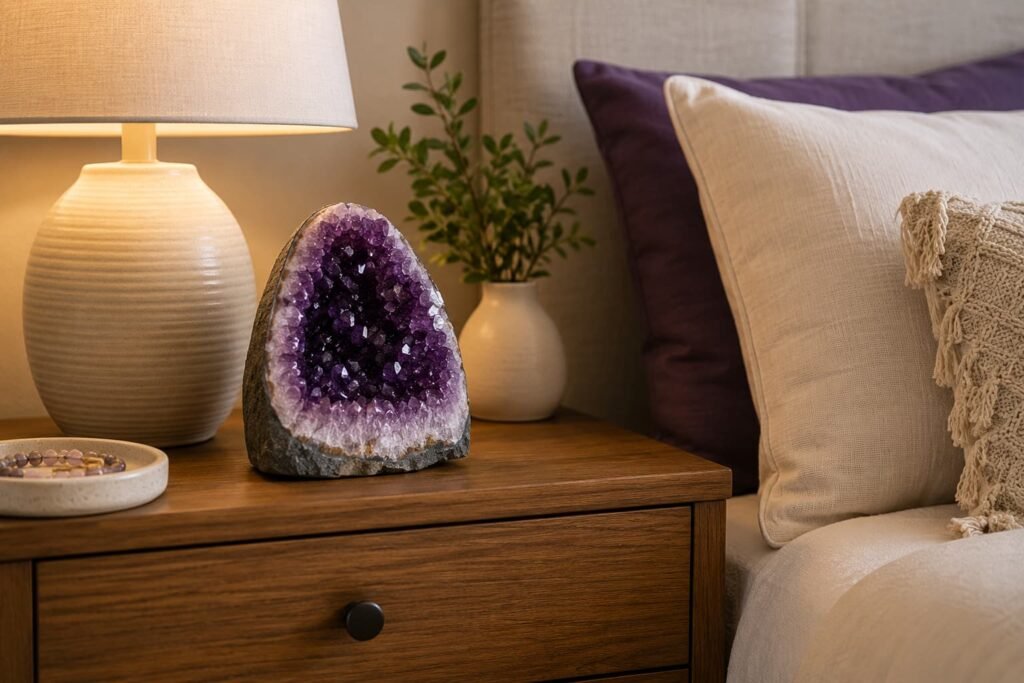
A small amethyst can be placed on a dresser, shelf, or bedside area if you enjoy having natural objects in your resting space.
Keep the arrangement simple rather than overcrowding your nightstand.
Living Room
Amethyst clusters can work beautifully on shelves, console tables, coffee tables, or alongside ceramics and other natural materials.
Its purple color can provide a subtle focal point without dominating the entire room.
Workspace
A small amethyst piece can add natural texture and visual interest to a desk or bookshelf.
Try combining it with natural wood, neutral colors, and an uncluttered workspace rather than surrounding it with too many decorative objects.
Meditation Corner
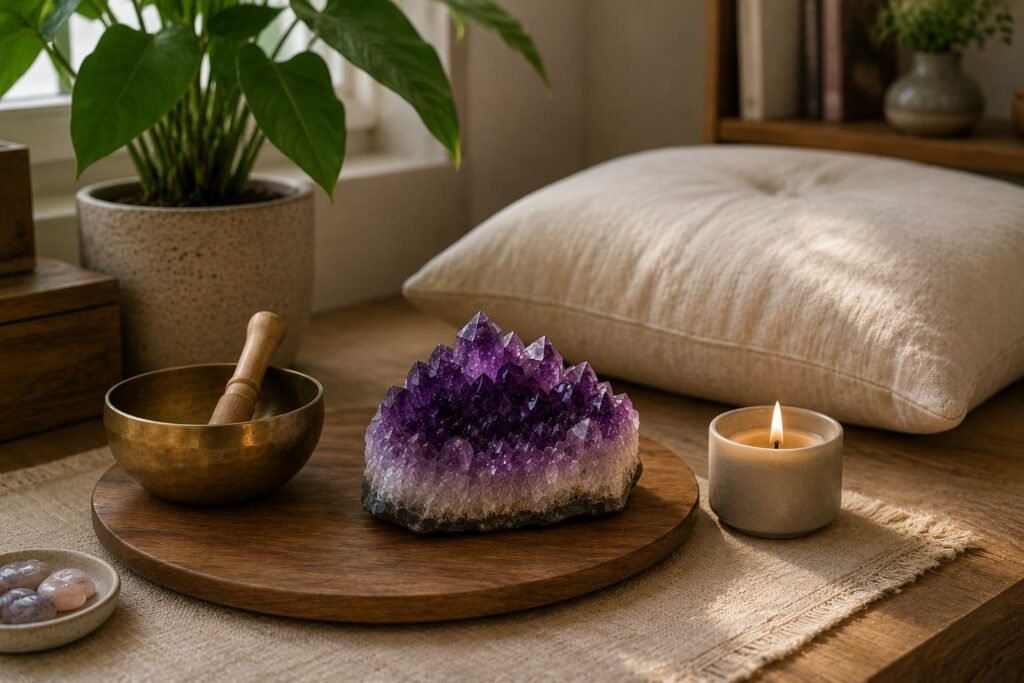
Amethyst is also easy to incorporate into a quiet meditation corner alongside a cushion, journal, candle, or other objects connected with your personal routine.
When deciding where to place amethyst, think less about rigid rules and more about the relationship between the object, the room, and the way you actually use the space.
For more room-by-room ideas, explore our 【Best Crystal Placement Rules for Every Room】 guide.
6. Amethyst and Mindful Living
One reason amethyst fits naturally into mindful living is that it does not need to “do” anything to have a purpose.
A beautiful natural object can encourage us to notice our surroundings.
Its color.
Its texture.
The way light passes through the crystal.
The fact that no two natural formations are exactly the same.
In a world filled with screens, notifications, and constant stimulation, keeping a few natural objects around us can create small opportunities to reconnect with the physical environment.
This is how we prefer to approach crystals at DaoMind.
Not as shortcuts to a perfect life, but as natural objects that can carry personal meaning, support intentional rituals, and become part of a more mindful environment.
7. How to Clean and Care for Amethyst
Proper care can help preserve the appearance of your amethyst over time.
For routine cleaning, gently remove surface dust with a soft, dry cloth or soft brush.
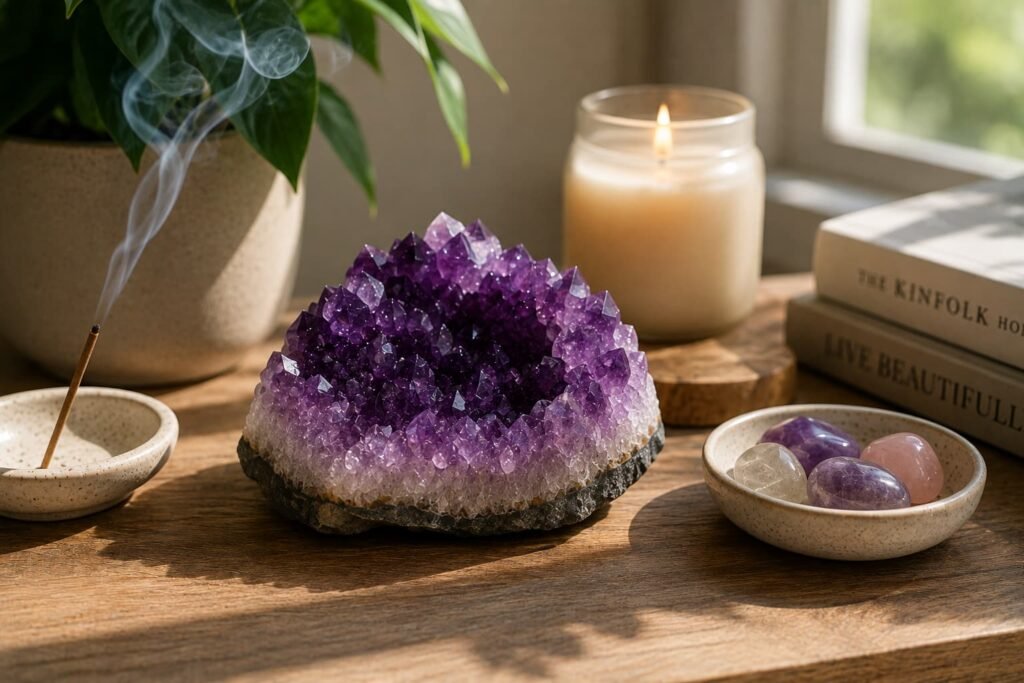
For suitable untreated amethyst pieces, mild warm soapy water can generally be used for physical cleaning, followed by careful rinsing and drying.
A few simple habits can help protect your amethyst:
- Avoid prolonged direct sunlight
- Avoid extreme heat
- Handle crystal points carefully
- Keep delicate pieces away from table edges
- Remove dust regularly
- Store pieces carefully when they are not on display
Long-term exposure to strong light or heat may affect the color of amethyst, so a bright room is fine, but prolonged intense direct sunlight is best avoided.
It is also useful to distinguish between physical cleaning and crystal cleansing.
Physical cleaning removes dust, oils, and dirt from the stone.
Crystal cleansing, on the other hand, refers to symbolic or spiritual practices used within some crystal traditions.
If you would like to explore those practices, read our complete 【How to Cleanse Your Crystals】 guide.
8. How to Choose an Amethyst
When choosing amethyst, begin with what you genuinely like.
Natural amethyst appears in a broad range of purple tones, and the “best” piece for your home does not necessarily have to be the darkest or largest one.
Consider four things:
Color
Do you prefer pale lavender, medium violet, or a deeper purple?
Different shades create very different visual impressions in a room.
Formation
Would you rather have a natural cluster, crystal point, geode, polished freeform, sphere, or tumbled stone?
Think about where you intend to use it.
Size
Is the amethyst intended for a bedside table, desk, bookshelf, meditation corner, or larger display area?
A small piece may work better in a compact space, while a larger cluster can become a natural focal point in a living room.
Natural Character
Are you comfortable with color zoning, inclusions, irregular edges, and other variations that naturally occur from piece to piece?
Natural crystals are not manufactured objects, so variation should be expected.
For decorative amethyst, personal preference matters just as much as size.
Choose something that fits naturally into your space rather than buying a larger piece simply because it appears more impressive.
9. Common Mistakes When Using Amethyst
Amethyst is easy to incorporate into daily life, but a few simple mistakes are worth avoiding.
Using Too Many Pieces in One Space
More is not always better.
A shelf filled with many crystals can quickly become visually busy. If your goal is to create a calm and intentional space, try starting with one or two pieces.
Leaving Amethyst in Strong Direct Sunlight
A sunny windowsill may look beautiful in photographs, but prolonged exposure to intense sunlight is not ideal for preserving amethyst color.
Choose a bright location without leaving the crystal under strong direct sunlight for long periods.
Choosing Only by Size
A larger crystal is not automatically a better crystal for your home.
Consider proportion, color, natural formation, and where the piece will actually be displayed.
Expecting a Crystal to Replace a Habit
If you want to create a calmer evening routine, improve your workspace, or develop a meditation practice, the crystal itself cannot build that habit for you.
Instead, allow it to become a meaningful object within the routine you create.
10. Amethyst FAQ
What Is Amethyst?
Amethyst is the purple variety of quartz. Its color can range from pale violet to rich reddish-purple and deep purple.
What Does Amethyst Symbolize?
In modern crystal traditions, amethyst is commonly associated with calm, reflection, clarity, mindfulness, intuition, and inner awareness.
These are traditional and symbolic associations rather than scientifically established medical effects.
Is Amethyst a February Birthstone?
Yes. Amethyst is traditionally recognized as the birthstone for February.
Can Amethyst Be Placed in the Bedroom?
Yes. If you enjoy having natural crystals in your bedroom, a small amethyst can be placed on a dresser, shelf, or bedside area.
Keep the arrangement practical and uncluttered.
Can Amethyst Fade in Sunlight?
Prolonged exposure to strong light and heat may affect the color of amethyst, so long-term direct sunlight is best avoided.
How Do You Clean Amethyst?
For regular physical cleaning, gently remove dust with a soft cloth or brush. Suitable untreated pieces can generally be cleaned with mild warm soapy water and dried carefully afterward.
Conclusion: Let Amethyst Become Part of Your Space
Amethyst does not need an elaborate ritual or complicated set of rules to become meaningful.
Its natural purple color, distinctive crystal formations, and long cultural history already make it a fascinating stone.
You can place it beside your journal.
Keep a small piece on your desk.
Add a cluster to a quiet corner.
Or simply appreciate it as a beautiful natural mineral.
The most meaningful way to use amethyst is often the one that fits naturally into your own life.
Choose intentionally. Place thoughtfully. And allow the crystal to become part of your space rather than something that overwhelms it.
Find an Amethyst for Your Space
Ready to bring natural crystals into your everyday space?
Explore the DaoMind Crystal Collection to discover natural crystals selected for mindful homes, personal rituals, and intentional living.
Not sure which crystal or piece is right for your space?
Contact DaoMind and tell us what you’re looking for. We’ll be happy to help you explore the collection and find an option that fits your space and preferences.
Tags: Amethyst, Amethyst Meaning, Amethyst Properties, Amethyst Uses, Beginner Crystal Guide, Crystal Care, Crystal Guide, Crystal Meanings, Mindful Living, Natural Crystals, Purple Quartz
Share Post

About author

Related posts
12
8 月
Best Crystals For Beginne... Continue reading
07
8 月
How To Cleanse Your Cryst... Continue reading
30
7 月
Clear Quartz Healing Prop... Continue reading
26
7 月
Rose Quartz Healing Prope... Continue reading
Add comment